
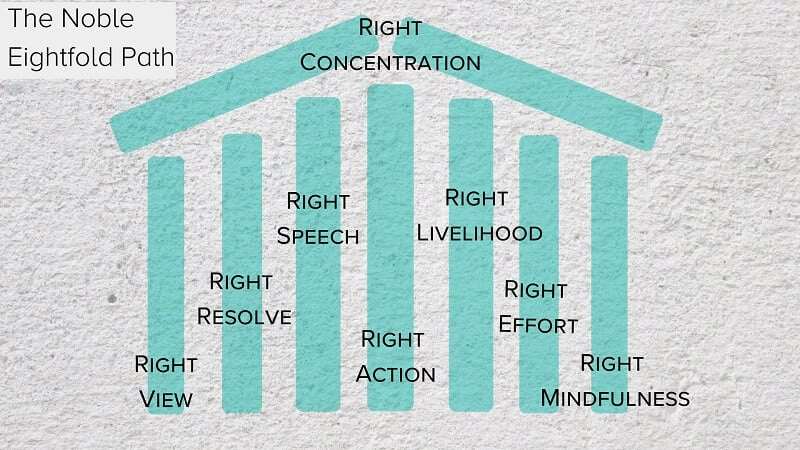
According to the Buddha, this consists of Right View, Right Resolve, Right Speech, Right Action, Right Livelihood, Right Effort, Right Mindfulness, and Right Concentration. The first seven are taught to be pillars that support Right Concentration. The Eightfold Path is the path to liberation from samsara. Without right concentration, one cannot overcome the ignorance of believing in an independently existing self which is the root of samsara. The remaining seven aspects are indispensable supports for developing Right Concentration.
Right View is the knowledge of the Four Noble Truths. For a deep dive on those, click here. When we have a true understanding of the Four Noble Truths, we realize that the further our perception from reality, the more we suffer.
- The Truth of Suffering: We are living in an ongoing state of dissatisfaction.
- The Truth of the Origin of Suffering: Suffering/dissatisfaction arises from causes and conditions.
- The Truth of Cessation: There is a possibility of reaching a state where that dissatisfaction/suffering has ceased.
- The Truth of the Path: There is a path for us to follow that will bring us to such a state.
How do the Eightfold Path and the Four Noble Truths fit together?
Therefore, to see reality through the lens of the four noble truths is to have “Right View,” which means the view which will lead us to truth and liberation. To deny these four truths or to live with a view that contradicts them will lead us to further confusion and dissatisfaction.
Right Resolve is to be resolved on renunciation—the wish to be freed from suffering, resolved on freedom. We gain this resolve by contemplating the precious human birth, death and impermanence, karmic causes and results, and the sufferings of samsara. By realizing that nothing in the realm of samsaric experience is a reliable source of happiness, we gain the wish to be free from the whole cycle.
Right Speech means to abstain from false, divisive, and harsh speech, as well as idle chatter. For example, if we are in a situation where people are talking negatively about someone else, we do not engage, and instead express that we do not want to take part in the conversation. We all know that moment when the office “water cooler” chit chat becomes harmful or divisive. We can take a moment and ask ourselves, “Are my words coming from a wholesome intention?” “Are my words aimed at tearing someone down?” “Are my words true?” Ideally, we choose to engage in Right Speech, which will lead to connection.
Right Action is more than simply holding the intention of causing no harm to ourselves and others but to ensure that what we are doing physically does not cause harm to any sentient beings. This means an avoidance of killing, injuring, stealing, and sexual misconduct.
Right Livelihood for monastics is to live from the donations of others and never take more than one needs. For laypeople, it means to avoid any livelihood that causes suffering to others by cheating, harming, or killing them. Whether we are business owners or employees, we can ensure that we are following ethically sound methods of making a living. If we are unemployed, we can ask ourselves if our means of survival are ethical and if we are causing harm to anyone else in our quest to meet our basic needs.
Right Effort means to diligently cultivate good qualities and to abandon non-virtuous thoughts and actions. The Buddha taught that if you want to be happy, there are certain behaviors that will help you attain that goal and others that will prevent it. In Buddhism, virtue is anything that causes happiness, and non-virtue is anything that causes suffering. To learn more about Buddhist virtues and non-virtues, click here. The primary means for developing right effort is to contemplate impermanence to see that we can’t delay in our endeavor since there is no guarantee that we will still be here tomorrow and to gain enthusiasm for the path by contemplating the benefits of liberation and the faults of samsara.
Right Mindfulness means to remain mindful of the body, feelings, consciousness, and mental phenomena while abandoning attachment and aversion. To learn more about mindfulness, click here. Simply put, it is to remain aware of what you are doing. As easy as this seems, when was the last time you were walking or taking transportation somewhere and completely lost track of where you were? It’s easy to lose track of what we are doing. We can ask ourselves “How am I existing in this moment?” or, “How is the world around me existing in this moment?”
To find the answers, we examine our body, mind, feelings, and surroundings. We can do so at the beginning of each day and from moment to moment throughout our days. This awareness leads to our responding to the reality of situations around us, rather than reverting to our immediate reactions.
The first seven of these pillars are supports for the eighth:
Right Concentration means to remain withdrawn from our senses and focused upon the object of our meditation while we practice. By avoiding counter-productive, harmful thoughts and actions, we develop a stable mind. We create a situation where our mind isn’t easily disturbed and can more naturally be directed in meditation. We become more skillful meditators.
These can also be broken down into three categories, referred to as the Three Higher Trainings:
- Ethics: Right Action, Right Speech, and Right Livelihood.
- Meditative Concentration: Right Mindfulness, Right Effort, and Right Concentration.
- Wisdom: Right View and Right Resolve.
These eight principles serve more as guides than eight steps to follow in order. We aim to apply them throughout our lives.
How can we apply the principles of the Eightfold Path to our lives?
Whatever the topic of our Dharma study, the most important thing is to apply it to our minds. To do that, it is crucial to develop a definitive understanding while knowing that the intellectual understanding on its own won’t be able to transform our minds or experiences. For example, merely knowing that we should avoid lying and knowing that lying leads to paranoia, distrust, and so forth is important. However, if we keep lying and make no effort to avoid it, we will continue to experience paranoia and sow the seeds of distrust. Similarly, we know that avoiding distractions is important to develop Meditative Concentration, but as long as we continue to involve ourselves in meaningless activities like social media overuse and unchecked desires for wealth and fame, we will not be able to make progress in our meditation.
As we make decisions daily, we can use these guiding principles to help us make choices that lead away from suffering and towards enlightenment.
Learn more about the Six Perfections in these blogs:
Or check out our Six Perfections YouTube playlist with Dharma talks on each perfection!
