

The essence of the Buddha’s teachings can be summed up with four short statements, referred to as the Four Noble Truths. While seemingly simple at first glance, fully realizing the depth of the Four Noble Truths requires tremendous contemplation and practice. After all, they are called the Four Noble Truths, not the Four Simple Steps to Attaining Enlightenment.
To achieve anything noble in this life requires effort and dedication, and so it is with the Four Noble Truths. For example, the Buddha underwent years of hardship and days and nights of practice before he found enlightenment and delivered the teaching of the Four Noble Truths.
So, what are these truths, and how did they come to be? Soon after the Buddha attained enlightenment in Bodhgaya, he taught the Four Noble Truths to his first five disciples in Sarnath.
And so began the Buddha’s famous teachings, which we know today as the Dharma. In giving us the Dharma (literally, “truth” in Sanskrit), he gave us the methods by which we can all come to experience what he had experienced, the ceasing of suffering and ultimate joy. The Buddha lived, wrote, and taught these methods for many years, establishing the first Buddhist Sangha, or spiritual community, the foundation for Buddhism as we know it today.
Here’s some good news for the skeptics: The Buddha didn’t ask people to practice these methods just because he said to; he felt that blind faith wasn’t worth much. Knowing that the faith of our own experience is unshakable, he asked people to try the methods for themselves to see if they worked for them. We can’t unknow something once we know it for ourselves.
What are the Four Noble Truths?
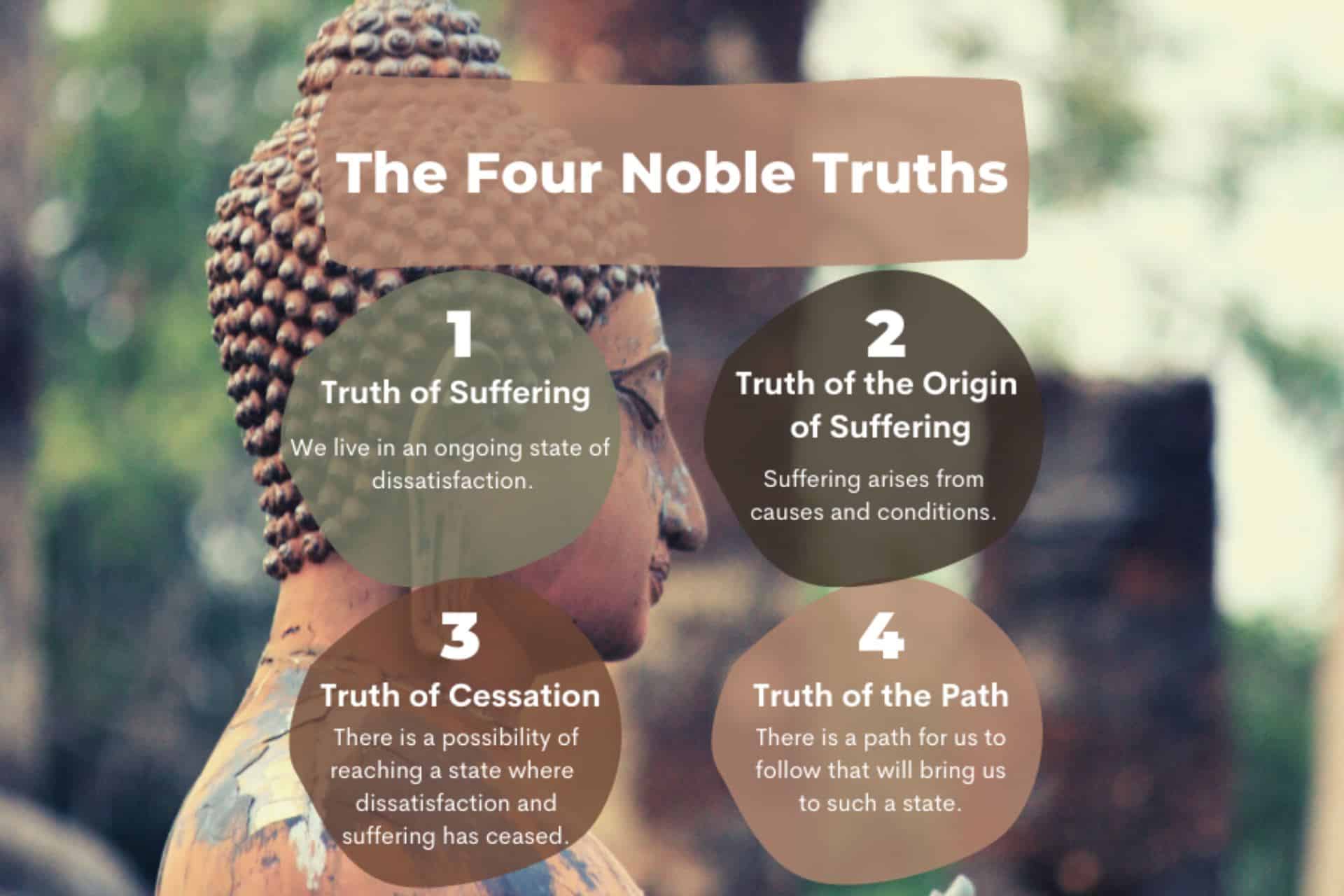
- The Truth of Suffering: We are living in an ongoing state of dissatisfaction.
- The Truth of the Origin of Suffering: Suffering/dissatisfaction arises from causes and conditions.
- The Truth of Cessation: There is a possibility of reaching a state where that dissatisfaction/suffering has ceased.
- The Truth of the Path: There is a path for us to follow that will bring us to such a state.
Why are the Four Noble Truths so important?
The Four Noble Truths form the basis of the entire path of Buddhist practice and the foundation of Buddhist Ethics. These ethics are not right or wrong merely because Buddhist teachings labeled them a certain way. What the Buddha taught is that if you want to be happy, there are specific behaviors that will help you reach that goal. On the other hand, some behaviors can also prevent you from achieving that goal. We often use “virtue” to label anything that causes happiness and “non-virtue” to label anything that causes suffering.

These truths explain both the causes and resultant sufferings of samsara and the causes and resultant state of liberation. Everyone wants happiness. No one wants to suffer. If we want to free ourselves from suffering, we must abandon its causes. If we want to attain liberation, we have to establish its causes. In summary, know the suffering, abandon its causes, actualize cessation, and rely upon the path.
Easier said than done, right? Here’s how we can know and learn to embody the Four Noble Truths.
The Four Noble Truths of Buddhism Explained
1. The First Noble Truth: The Noble Truth of Suffering
Samsara is the term that refers to this state of suffering and/or ongoing dissatisfaction. When we say “suffering,” it’s not necessarily extreme pain or trauma. Suffering refers to everything being temporary and impermanent: we constantly desire temporary solace in things, people, feelings, and experiences. Likewise, we are also fleeting, as we will eventually die. Samsara isn’t a place; instead, it is a state of mind where we are never perfectly comfortable or satisfied. Even if we are for a moment, dissatisfaction quickly returns.
When the Buddha taught the first noble truth of suffering, he introduced a way of seeing the world and understanding lived experiences. The wish to attain liberation from samsara is called the mind of renunciation. Renunciation doesn’t mean you have to give away all of your possessions, run to India, and get ordained. It means recognizing that you are fed up with the cycle of clinging, craving, dissatisfaction, and suffering. The Mind of Renunciation is a wish to overcome these states, and the first step to enlightenment.
2. The Second Noble Truth: The Noble Truth of the Causes of Suffering
Once we see the reality of suffering, we can recognize its causes. The Buddha taught that suffering results from our actions (karma) and our afflictive thoughts and emotions. It’s easy to blame our suffering on external causes like other people or situations. However, our happiness and suffering depend on our own actions and perception.
If we don’t want to suffer, there are specific actions and attitudes we should avoid. For example, if we lie to others, we will live with the stress and paranoia that whoever we lied to may find out the truth. If so, we may lose their trust and friendship. To avoid suffering, we must know its causes and act accordingly.
The system of ethics taught by the Buddha is very practical. It isn’t a command; commands are hard to follow. The Buddha never said, “Don’t do this or that just because I said so.” Typically, that approach doesn’t work very well with people. The Buddha taught virtues to practice and non-virtues to avoid if you want to end suffering and gain happiness. Once we see the truth of this, we want to follow that system of Ethics because it is in our best interest to do so.
3. The Third Noble Truth: The Noble Truth of the Cessation of Suffering
The Truth of Cessation is that there is an end to the causes and resultant sufferings/dissatisfaction of samsara. This state of complete, permanent freedom from ignorance and attachment is called Buddhahood or the fully enlightened state. It is a state of peace in which suffering and afflictive thoughts and emotions will never arise again.
This cessation is not brought about by turning the mind off or making it so dull or sleepy that it can’t function. The realization of ultimate reality brings about Buddhahood. It’s important to remember that we all possess this Buddha nature, and through practice, we gain the wisdom to see it. The practices that bring about this realization are called “the Path.”

4. The Fourth Noble Truth: The Noble Truth of the Path to the Cessation of Suffering
The Truth of the Path refers to the “Path” we traverse to attain Buddhahood—full liberation (from samsara). In our pursuit, our mind awakens to the profound truth of the nature of reality. This realization is an antidote to some misapprehension of reality we previously held. For example, when we come to some new awareness or realization about Impermanence, we dispel our conscious or subconscious beliefs that things will always remain as they are.
There are many definitions of the Path presented in Buddhist texts, but the main point is that by practicing the Path, we will uproot the causes of suffering and experience the peace and ever-joyful state of Buddhahood.
Want more dharma in your life?
Sign up for our Weekly Dharma newsletter and start each week with a dose of Buddhist wisdom.
Related Blog Posts


